It's 7:45 AM and you find yesterday's lunchbox squished in the backpack. Your child is crying because their favorite pants are in the laundry. You take a deep breath – and feel like the worst mother in the world. But what if I told you: it's precisely these moments that prepare your child for life? Imperfection is not a flaw – it is the foundation of real relationships.

The Lie of the Perfect Mother – and Why It Exhausts Us All
We live in a time where motherhood has become a high-performance sport. Organic snacks, educational toys, mindful communication around the clock – the pressure is immense. Yet behind every perfectly staged photo lies a reality full of doubts, tears, and overwhelm.
The truth? No child needs a perfect mother. Children need a real mother – one who fails sometimes, apologizes, and shows feelings. Because that’s how they learn that mistakes are human and that love is not tied to performance.
- Perfectionism teaches children that mistakes are unacceptable
- Imperfection shows that failure is part of life
- Authenticity creates emotional security
- Vulnerability is the foundation for real connection
What Children Really Learn When Mom is "Imperfect"
Imagine: You lose your patience, yell – and then apologize to your child. What happens in that moment? Your child learns that mistakes can be fixed. That relationships can withstand conflicts. That no one has to be strong all the time.

Research shows: Children who see their parents make mistakes and own up to them develop a healthier attitude towards mistakes. They feel more capable, are more resilient, and have a more realistic self-image. So your “shortcomings” are not a failure – they are a gift.
Everyday Examples that Inspire
- The forgotten birthday gift: Shows that love is not measured in perfection – and that problem-solving together brings you closer
- The burned birthday cake: Teaches humor and flexibility (and that pizza is also an option)
- The missed school performance: Opens the conversation about priorities, disappointment, and making amends
- The evening meltdown: Demonstrates that adults also have feelings – and how to deal with them
Why Imperfection Deserves to be Celebrated – a Radical Shift in Perspective
What if we stopped berating ourselves for our “mistakes” – and instead celebrated what they teach us? Every forgotten homework assignment, every half-hearted craft session, every day with too much screen time is also proof that you are a human being. Not a robot. Not a machine.
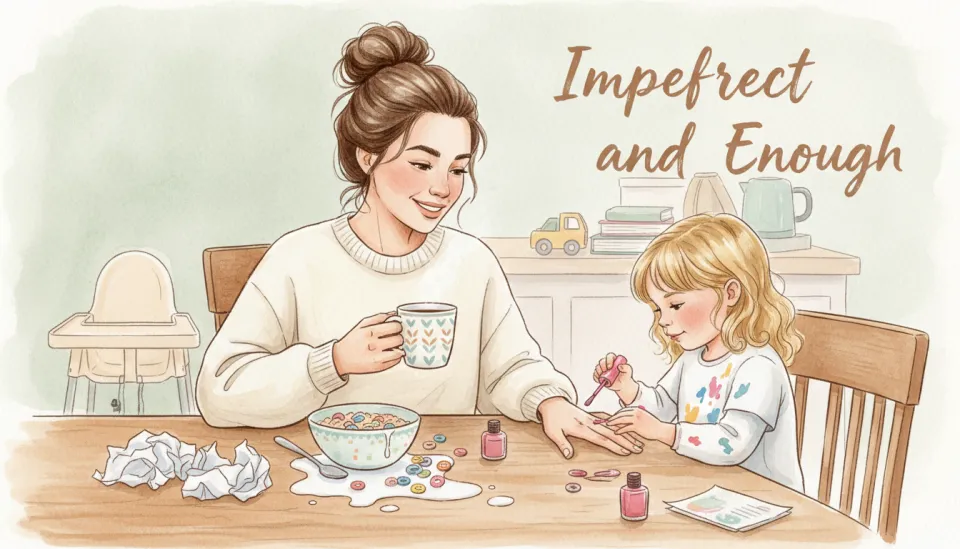
Rewarding doesn't mean we can't keep growing. It means: Acknowledging that we are doing our best – and that is enough. It means treating ourselves with the same patience that we want to extend to our children.
How to Actively Appreciate Imperfection
- Keep an "Imperfect Journal": Write down a "mistake" each day – and what it taught you
- Talk openly with your child about your limits: "Mommy is tired today and needs a break"
- Celebrate small victories: The day was chaotic, but you laughed together
- Share honestly with other mothers – without filters
- Allow yourself to accept help (that’s not a weakness!)
The Power of Self-Compassion – Your Most Important Tool
Self-compassion is not an esoteric luxury. It is the foundation of mental health – your and your child's. When you learn to treat yourself lovingly, you model the behavior you want for your child.

Practically, this means: When you make a mistake, talk to yourself like you would to your best friend. Not: "I am so incompetent." But: "That was hard today. I did my best. Tomorrow is a new day." This inner dialogue shapes how your child will later speak to themselves.
A Letter to You – the Imperfect, Wonderful Mother
Dear Mom, you are enough. Not despite your imperfection – because of it. Because you are real. Because you feel. Because you try anew every day. Your child won’t remember the perfectly packed lunchbox – but your hug after a long day. Your laughter. Your apology when you were too hard on them.

The world doesn't need more perfect facades. It needs mothers who show: It’s okay to not be okay. Those who model that love is unconditional. Who give their children the greatest gift – the permission to be human.
So: Take a deep breath. Be gentle with yourself. And when everything goes wrong again today – remember that it’s precisely these moments that teach your child what really matters. You’re doing great. Imperfect and beautiful.
Medical Disclaimer
The information provided in this article is for educational purposes only and is not intended as a substitute for professional medical advice, diagnosis, or treatment. Always seek the advice of your physician or other qualified health provider with any questions you may have regarding a medical condition. Never disregard professional medical advice or delay in seeking it because of something you have read on this website.
Similar Posts
Meal Prep for Moms: 7 Energetic Recipes You Can Cook in 2 Hours
Between childcare, household chores, and everything else, there's hardly any time left for cooking. Discover how to prep...
5 Mini Rituals That Transform the Chaotic Day-Night Transition with Baby in 10 Minutes
Does the evening with your baby feel like a race against time? These science-backed mini rituals create a sense of safet...
5 Practical Tips for a Healthy Mama Energy Balance – How to Recharge for Real
You know the feeling: In the evening, you're more exhausted than after a marathon, even though you’ve “only” been a mom....
When Daily Life Overwhelms You: 3 Breathing Exercises That Give You True Calm in Just 2 Minutes
The baby is crying, the laundry is piling up, and your heart is racing? These three simple breathing exercises will help...